Menu

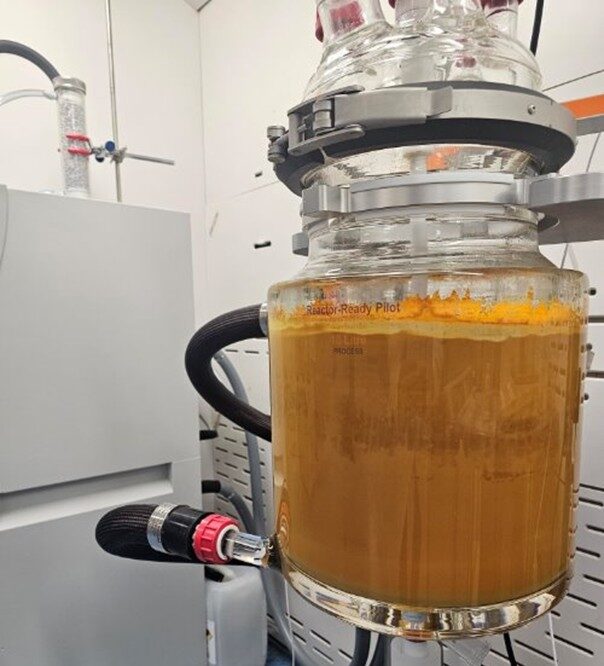
We combine cutting-edge scientific expertise with proven industrial know-how to design the next generation of printable organic semiconductors. Developed from rigorously controlled conjugated polymer backbones and functionalized side chains, these materials form the foundation of printed devices such as organic photovoltaics, OLED displays, and organic sensors. At Brilliant Matters, we engineer materials designed not only for today’s innovations but also for tomorrow’s production lines. Scalability is therefore at the very core of our identity, embedded in both our product development and our manufacturing processes.
The production of organic semiconductors relies on standard methods and equipment similar to those used in the fine chemicals and pharmaceutical industries. However, Brilliant Matters stands out by employing proprietary technologies and exclusive purification processes, ensuring materials of unmatched purity and yield.
At the heart of our technology platform lies an innovative method for producing polymer semiconductors: direct heteroarylation polymerization (DHAP). Developed at Université Laval by Professor Mario Leclerc and the co-founders of Brilliant Matters, this approach revolutionizes the synthesis of organic semiconductors. Unlike traditional polymerization methods, which generate byproducts containing toxic metals (such as organotins), DHAP directly forms carbon–carbon bonds between aromatic units using stable, unmodified, and more environmentally benign precursors.
This innovation provides decisive advantages:

At Brilliant Matters, quality is not an added feature—it is the foundation of everything we do. In the field of printed organic photovoltaics, where device performance depends on molecular precision, we are uniquely positioned to manufacture, purify, and scale organic semiconductors to meet industrial demands. From gram-scale laboratory batches to multi-kilogram production, our precision-controlled synthesis, purification, and formulation workflows safeguard material integrity at every stage. This is not simply production—it is industrial-grade consistency, purpose-built for the next generation of solar technology.
In OPV manufacturing, maintaining a consistent molecular weight distribution is critical. Even small variations can significantly alter ink viscosity, affecting layer thickness and uniformity during high-speed roll-to-roll printing. Leveraging advanced polymerization and characterization techniques, Brilliant Matters achieves MW control within 5% tolerance, ensuring batch-to-batch reproducibility. This reduces variability, streamlines device fabrication, and strengthens quality assurance in solar module production.
Trace impurities are another key challenge: even at minimal levels, they can suppress OPV efficiency and compromise long-term stability. Residual catalysts such as palladium (Pd) or metallic nanoparticles are known to quench excitons or introduce trap states, lowering power conversion efficiency and accelerating degradation. Our proprietary purification systems eliminate these contaminants, consistently delivering materials that exceed industry purity benchmarks.
Beyond OPV, our scalable high-purity materials enable advances in organic photodetectors, printed sensors, and microelectronics. At Brilliant Matters, performance, purity, and scalability converge—delivering the organic semiconductor materials that will drive the future of clean, lightweight, and integrated printed electronics.
Job application
Want to take part in challenges that matters? Join us to be part of a brilliant future!