o-IDTBR
PhotovoltaïqueDescription
*Jusqu’à épuisement des stocks
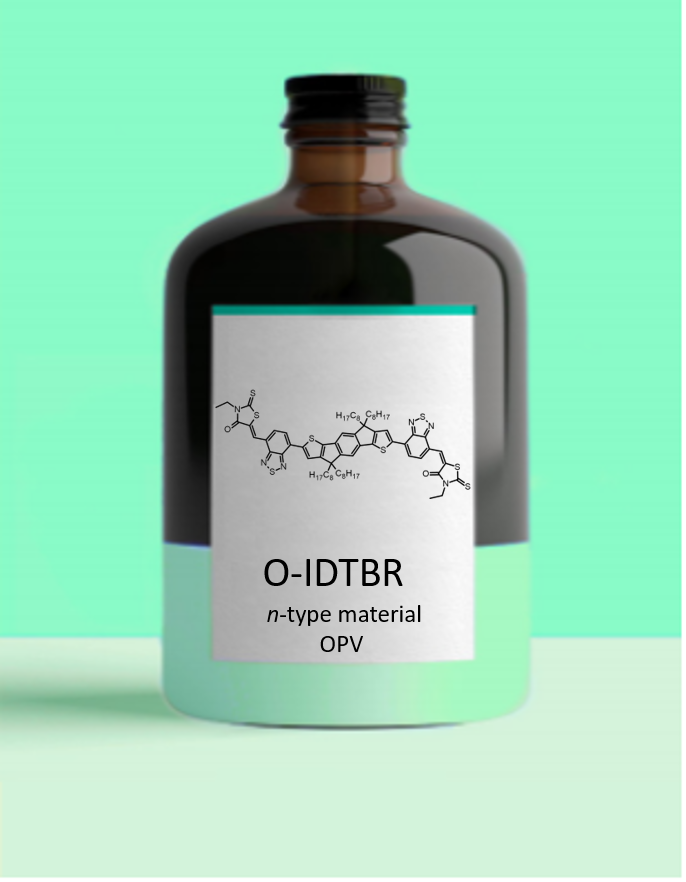
Le o-IDTBR a été initialement utilisé avec le polymère P3HT pour fabriquer des dispositifs OPV remarquablement stables à l’air, atteignant un rendement de conversion de puissance (PCE) supérieur à 6,3 %. Comparés aux dispositifs à base de fullerènes, ceux à base de o-IDTBR ont montré une stabilité nettement améliorée, conservant 73 % de leur efficacité initiale après 1200 heures de stockage dans l’obscurité. L’introduction d’un mélange ternaire avec IDFBR a permis de porter l’efficacité du système à 7,7 %. Les dispositifs fabriqués avec ce mélange ont maintenu plus de 85 % de leur efficacité initiale après 90 heures en air sous une illumination 1 sun. En comparaison, les dispositifs P3HT:PC71BM ont complètement échoué après 50 heures dans ces mêmes conditions.
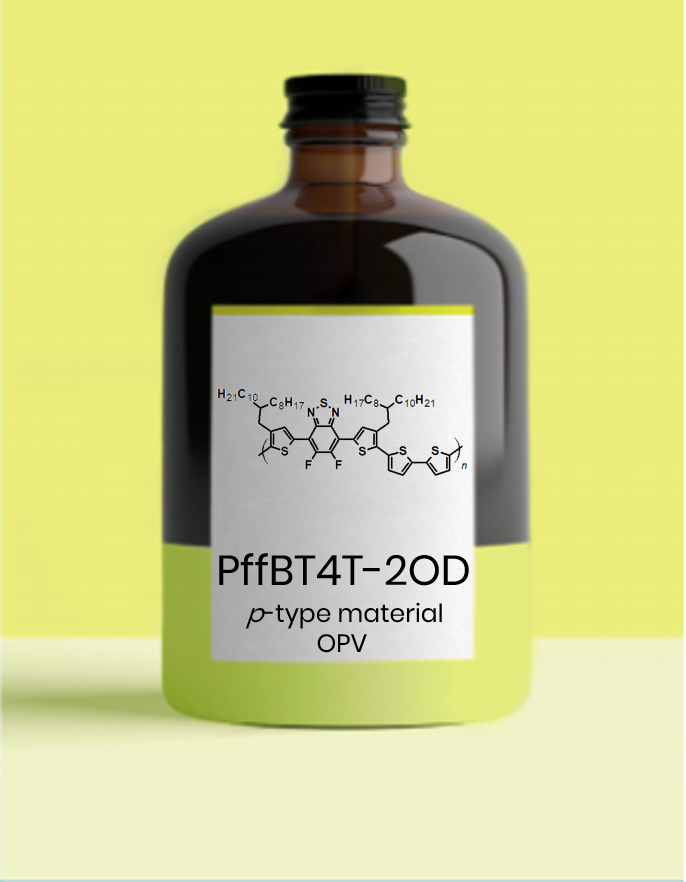
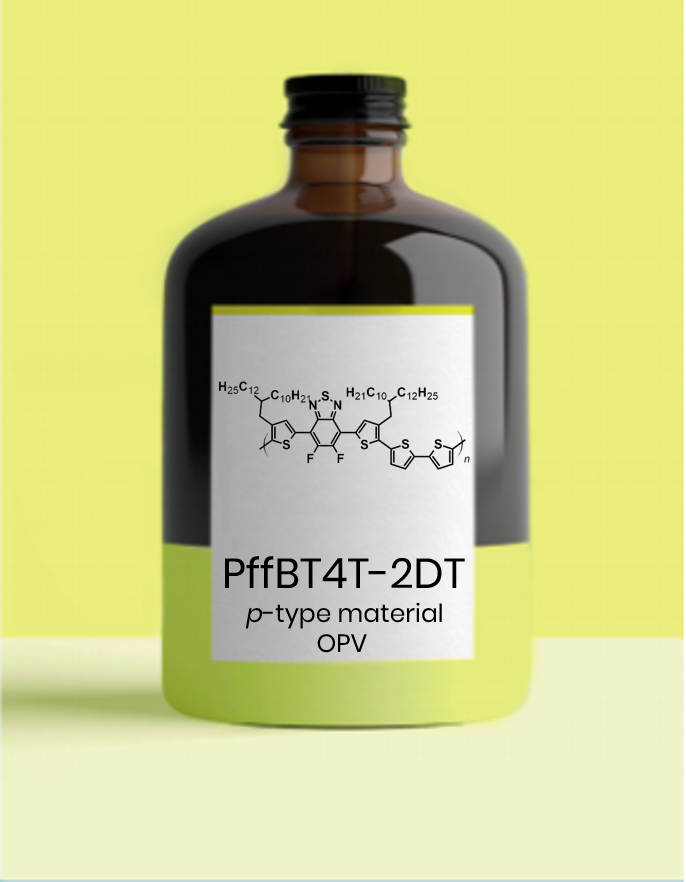
Le o-IDTBR a également démontré son potentiel avec d’autres polymères, atteignant des rendements proches de 10 % en combinaison avec le polymère PffBT4T-2DT, grâce à une réduction des pertes de tension et une tension en circuit ouvert (Voc) élevée de 1,12 V. Un rendement supérieur à 11 % a également été obtenu avec le polymère PTB7-Th.
Références
[1] Holliday, S.; Ashraf, R. S.; Wadsworth, A.; Baran, D.; Yousaf, S. A.; Nielsen, C. B.; Tan, C.-H.; Dimitrov, S. D.; Shang, Z.; Gasparini, N.; Alamoudi, M.; Laquai, F.; Brabec, C. J.; Salleo, A.; Durrant, J. R.; McCulloch, I., High-efficiency and air-stable P3HT-based polymer solar cells with a new non-fullerene acceptor. Nat. Commun. 2016, 7, 11585.
[2] Baran, D.; Kirchartz, T.; Wheeler, S.; Dimitrov, S.; Abdelsamie, M.; Gorman, J.; Ashraf, R. S.; Holliday, S.; Wadsworth, A.; Gasparini, N.; Kaienburg, P.; Yan, H.; Amassian, A.; Brabec, C. J.; Durrant, J. R.; McCulloch, I., Reduced voltage losses yield 10% efficient fullerene free organic solar cells with >1 V open circuit voltages.Energ. Environ. Sci. 2016, 9 (12), 3783-3793.
[3] Baran, D.; Ashraf, R. S.; Hanifi, D. A.; Abdelsamie, M.; Gasparini, N.; Röhr, J. A.; Holliday, S.; Wadsworth, A.; Lockett, S.; Neophytou, M.; Emmott, C. J. M.; Nelson, J.; Brabec, C. J.; Amassian, A.; Salleo, A.; Kirchartz, T.; Durrant, J. R.; McCulloch, I., Reducing the efficiency–stability–cost gap of organic photovoltaics with highly efficient and stable small molecule acceptor ternary solar cells. Nature Materials 2017, 16 (3), 363-369.
[4] Chen, S.; Liu, Y.; Zhang, L.; Chow, P. C. Y.; Wang, Z.; Zhang, G.; Ma, W.; Yan, H., A Wide-Bandgap Donor Polymer for Highly Efficient Non-fullerene Organic Solar Cells with a Small Voltage Loss. J. Am. Chem. Soc. 2017, 139 (18), 6298-6301.
[5] Gasparini, N.; Salvador, M.; Heumueller, T.; Richter, M.; Classen, A.; Shrestha, S.; Matt, G. J.; Holliday, S.; Strohm, S.; Egelhaaf, H.-J.; Wadsworth, A.; Baran, D.; McCulloch, I.; Brabec, C. J., Polymer:Nonfullerene Bulk Heterojunction Solar Cells with Exceptionally Low Recombination Rates. Adv. Energy Mater. 2017, 7 (22), 1701561.
[6] Qian, D.; Zheng, Z.; Yao, H.; Tress, W.; Hopper, T. R.; Chen, S.; Li, S.; Liu, J.; Chen, S.; Zhang, J.; Liu, X.-K.; Gao, B.; Ouyang, L.; Jin, Y.; Pozina, G.; Buyanova, I. A.; Chen, W. M.; Inganäs, O.; Coropceanu, V.; Bredas, J.-L.; Yan, H.; Hou, J.; Zhang, F.; Bakulin, A. A.; Gao, F., Design rules for minimizing voltage losses in high-efficiency organic solar cells. Nature Materials 2018, 17 (8), 703-709.
Spécifications techniques
CATALOG NAME
o-IDTBR
NAME
5,5'-[[4,4,9,9-Tetraoctyl-4,9-dihydro-s-indaceno[1,2-b:5,6-b']dithiophene-2,7-diyl]bis(2,1,3-benzothiadiazole-7,4-diylmethylidyne)]bis[3-ethyl-2-thioxo-4-thiazolidinone]
CAS NUMBER
2077945-91-4
FORMULA
C72H88N6O2S8
MOLECULAR WEIGHT
1326.03 g/mol
Purity
> 99% (HPLC)
HOMO
-5.51 eV
LUMO
-3.88 eV
Bandgap (optical)
1.63 eV
 MSDS